Need help?
A DOT drug or alcohol violation does not disappear from the FMCSA Clearinghouse as soon as a driver completes the Return-to-Duty process. The Clearinghouse separates a driver's current eligibility to perform safety-sensitive work from the retention of historical violation information.
That distinction explains how a driver can be Not Prohibited and legally eligible for covered work while a previous violation still remains in the Clearinghouse record.
FMCSA's Clearinghouse retention rule generally keeps drug and alcohol violation information for five years from the date of the violation or until the Return-to-Duty process is completed, whichever is later.
The words “whichever is later” are important. If a driver completes the Return-to-Duty process relatively quickly, the violation can still remain for the applicable five-year period. If the driver leaves the violation unresolved for longer than five years, waiting alone does not cause the unresolved record to disappear.
The Return-to-Duty requirements still have to be satisfied if the driver wants to regain eligibility for covered safety-sensitive work.
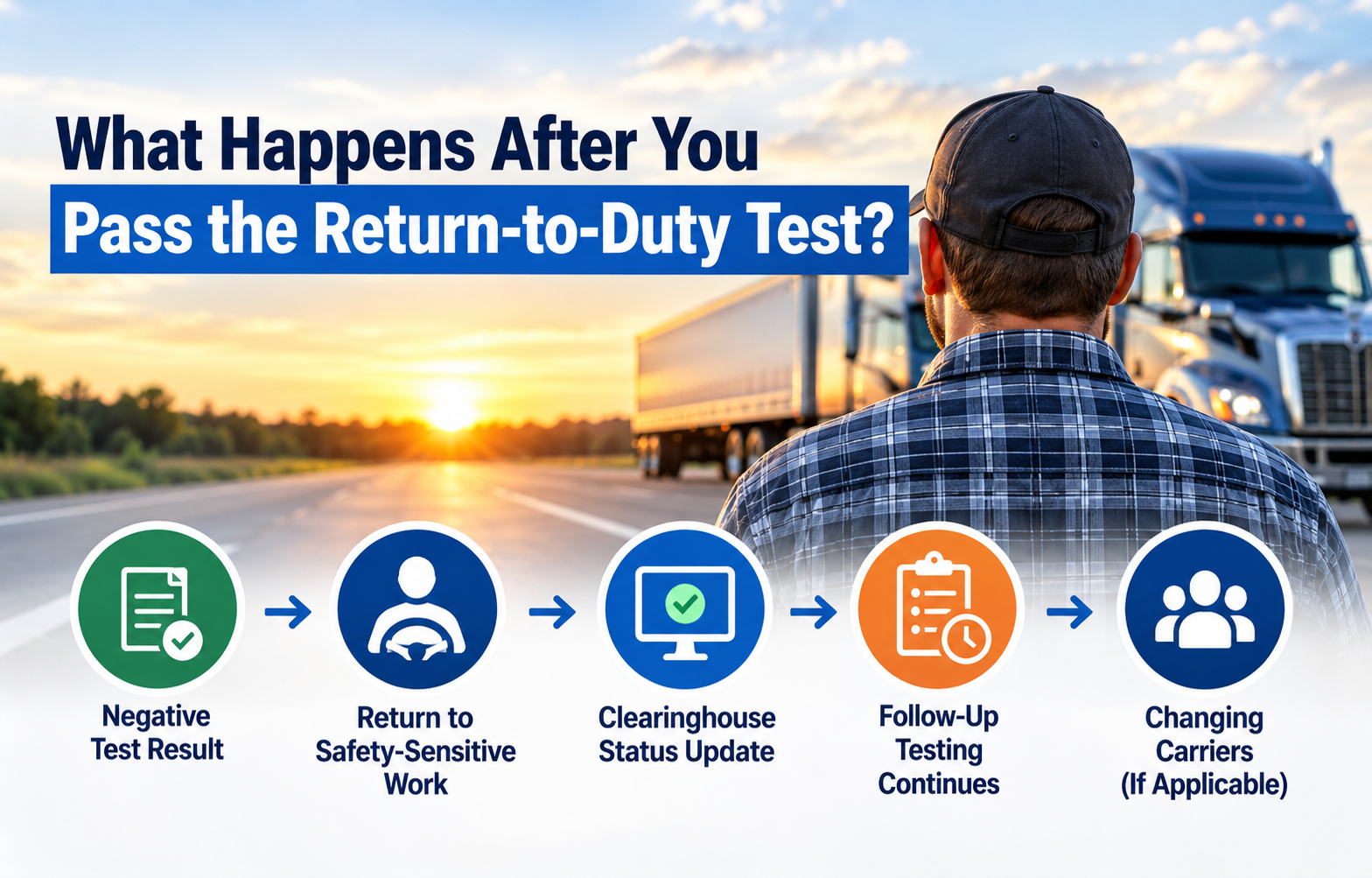
A driver's current status can change before the historical violation reaches the end of its retention period. After successful SAP compliance, the required Return-to-Duty test, and proper reporting, a driver can move from Prohibited to Not Prohibited when the federal requirements are met.
Not Prohibited means the drug and alcohol rules no longer prohibit the driver from performing safety-sensitive functions on the basis of that unresolved status. It does not mean the underlying violation record has been erased.
This is why drivers should check both the current status and the details of the retained history rather than treating them as the same thing.
Consider a driver who completes the Return-to-Duty process soon after a violation. The driver can regain eligibility to work, yet the historical violation may remain during the five-year retention period.
Now consider a driver who does not complete the Return-to-Duty process for more than five years. The five-year mark does not provide an automatic escape from the unresolved process because the retention rule uses the later of the two events.
These examples show why “How long does it stay?” and “When can I drive again?” are two separate questions.
Since November 18, 2024, the Clearinghouse-II rule connects Prohibited status with state CDL and CLP actions. A driver's Clearinghouse record, current Prohibited or Not Prohibited status, and state commercial driving privileges are therefore related even though they are not identical records.
A driver resolving a violation should verify the actual Clearinghouse status and, when relevant, the state licensing status rather than relying only on the age of the violation.
For a driver, the practical priority is resolving the Return-to-Duty process and understanding the current Clearinghouse status. For employers, required Clearinghouse queries provide information used to determine whether a CDL driver is prohibited from performing safety-sensitive functions.
Historical retention should not be confused with a permanent prohibition. A retained violation record and a current Not Prohibited status can exist at the same time.
Keeping those concepts separate makes it much easier to understand what a completed SAP process actually changes and what remains visible afterward.
For the current federal rules and official guidance, use the DOT and FMCSA resources below.
Continue with related guides about the DOT SAP Program, Return-to-Duty process, Clearinghouse, and follow-up testing.

© 2026 SAPTruckingJobs.com. All Rights Reserved.